THE MECHANISM ROOM / ANATOMY OF A WATCH
Look beneath the dial.
There is much more to a watch than its case and hands. Learn the purpose of its components—then see how the power source, transmission and regulator work together.
Original educational diagrams are conceptual, not disassembly instructions or precise illustrations of a particular manufacturer’s caliber.
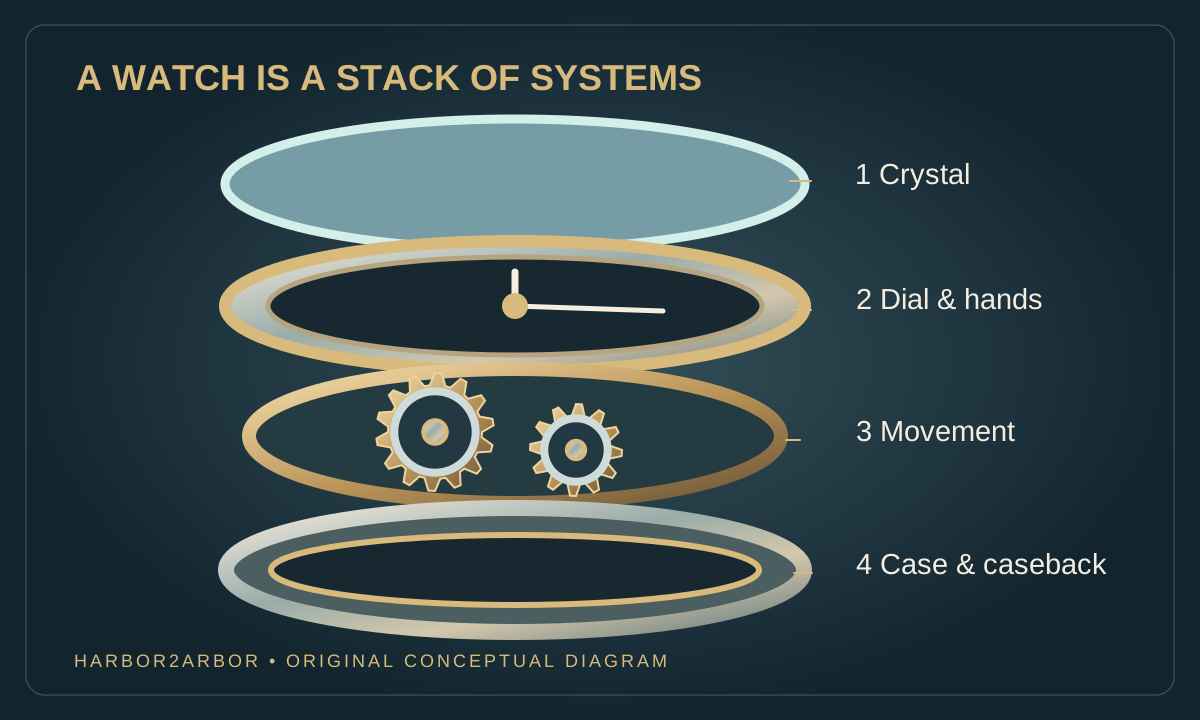
01 / CASE ARCHITECTURE
The outside protects the inside
Case, crystal, dial, hands and caseback
A wristwatch is several engineered systems stacked in a very small space. Its crystal protects the readable dial and hands; the case holds the movement securely, and the caseback provides access for properly trained servicing. The crown and its stem communicate with the movement to wind or set it.
A bezel may surround the crystal and sometimes rotate for elapsed-time use. Gaskets and carefully fitted surfaces may help keep water and dust away from the movement. A claimed water-resistance rating applies to a specific watch under defined test conditions, not to every example after years of wear.
The diagram is deliberately conceptual; actual movements, case constructions and fastening systems differ. A quartz watch can use a similar case and dial arrangement even though the regulating mechanism inside is electronic.
Continue reading: More about this ↗ · Related history ↗
02 / THE POWER SOURCE
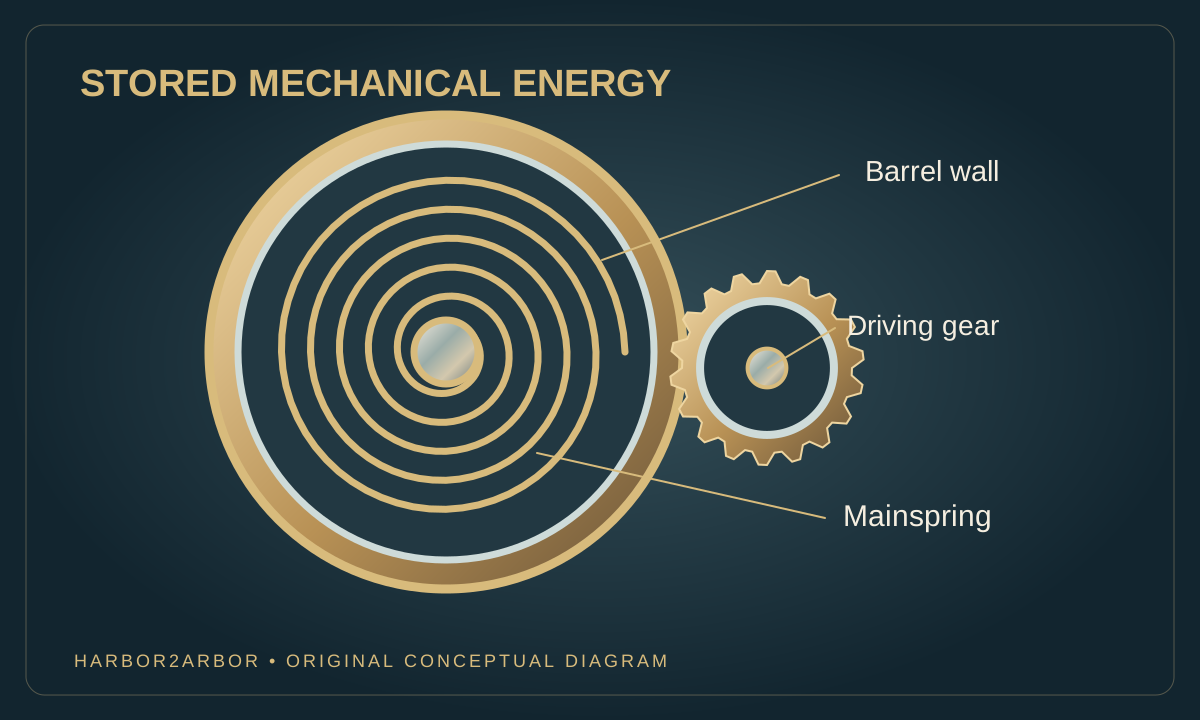
The mainspring stores power
Barrel, spring and stored mechanical energy
A wound mainspring stores energy as elastic tension. Its barrel transfers that energy to the train of wheels. When someone turns a manual winding crown, they add energy; an automatic movement can use wrist motion to replenish the same sort of stored energy.
The spring's torque does not remain completely constant as it unwinds. Watchmakers use design choices, regulation and escapement behavior to help the watch maintain a reasonably stable rate despite that change.
Power reserve refers to the amount of time a watch can typically run on its stored energy. It is a different specification from accuracy. A longer power reserve does not by itself mean a better-regulated movement.
Continue reading: More about this ↗ · Related history ↗
03 / THE GEAR TRAIN
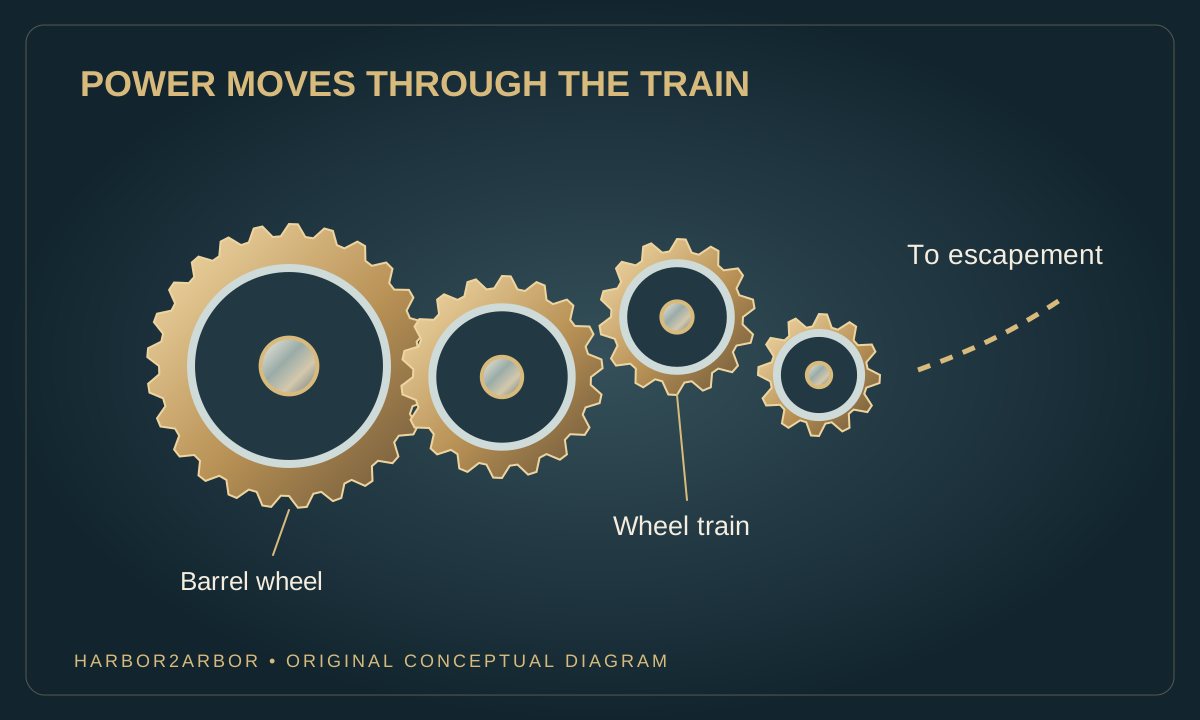
Wheels turn motion into useful ratios
The movement's power-transmission system
Gear trains take rotation from the mainspring barrel and pass it through carefully chosen tooth counts. Some wheels influence the speed with which energy arrives at the escapement; other gearing drives the hands at the right ratio so minutes and hours can be read.
The wheels sit in tiny bearings supported by the movement's plates and bridges. Precision comes from much more than tooth shapes: pivot size, alignment, lubrication and the way parts are secured all matter.
Decorated bridges and skeletonized designs may make some of this machinery visible, but not every visible gear is responsible for the same function. Watchmakers diagnose problems by following energy and motion through the specific caliber.
Continue reading: More about this ↗ · Related history ↗
04 / THE REGULATOR
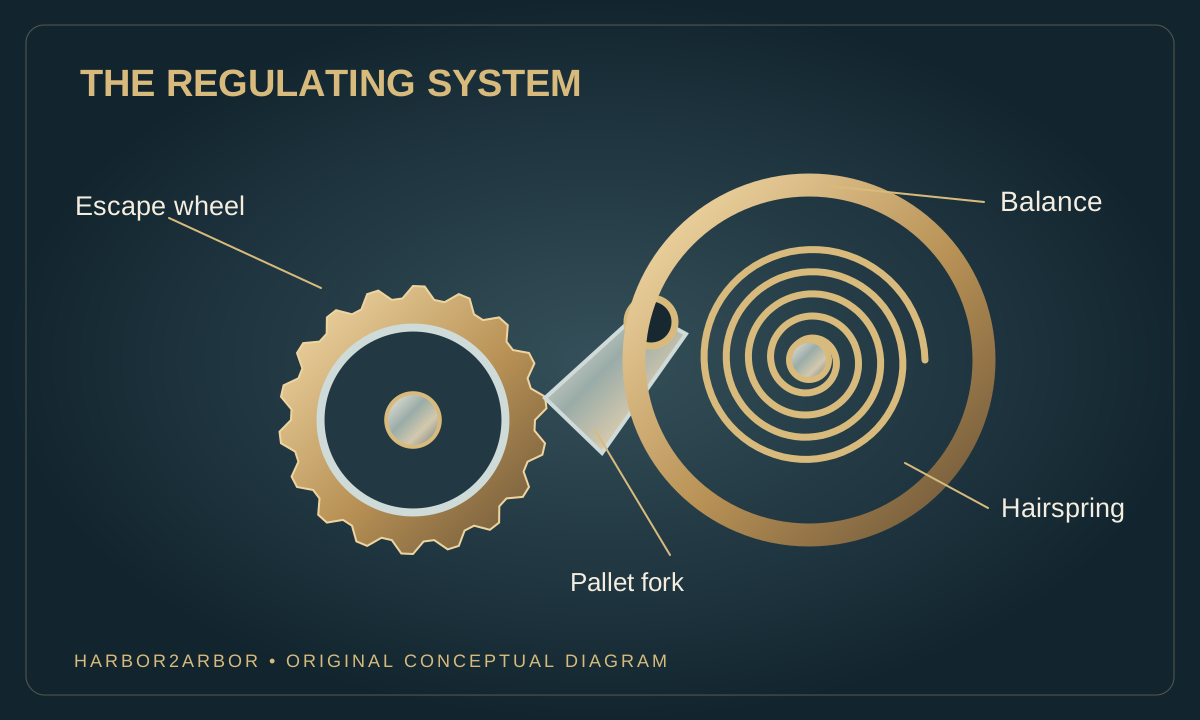
Escapement and balance establish rhythm
The source of a mechanical watch's ticking
A conventional Swiss lever escapement alternately holds and releases an escape wheel. It also supplies small impulses to the balance, helping replenish the energy lost to friction. The balance spring pulls the balance toward its neutral position to create repeated oscillations.
Beat rate describes how frequently those oscillations occur. The rate of the watch depends on its regulation, manufacturing quality, position, temperature, wear and other influences. The escapement meters the release of power, but the balance provides the regular timing reference.
Other systems change that arrangement. Breguet's tourbillon rotates the regulating assembly to average some positional effects, while George Daniels' co-axial escapement alters how impulse is delivered. The simplified picture is not a blueprint for assembling a working movement.
Continue reading: More about this ↗ · Related history ↗
05 / SELF-WINDING
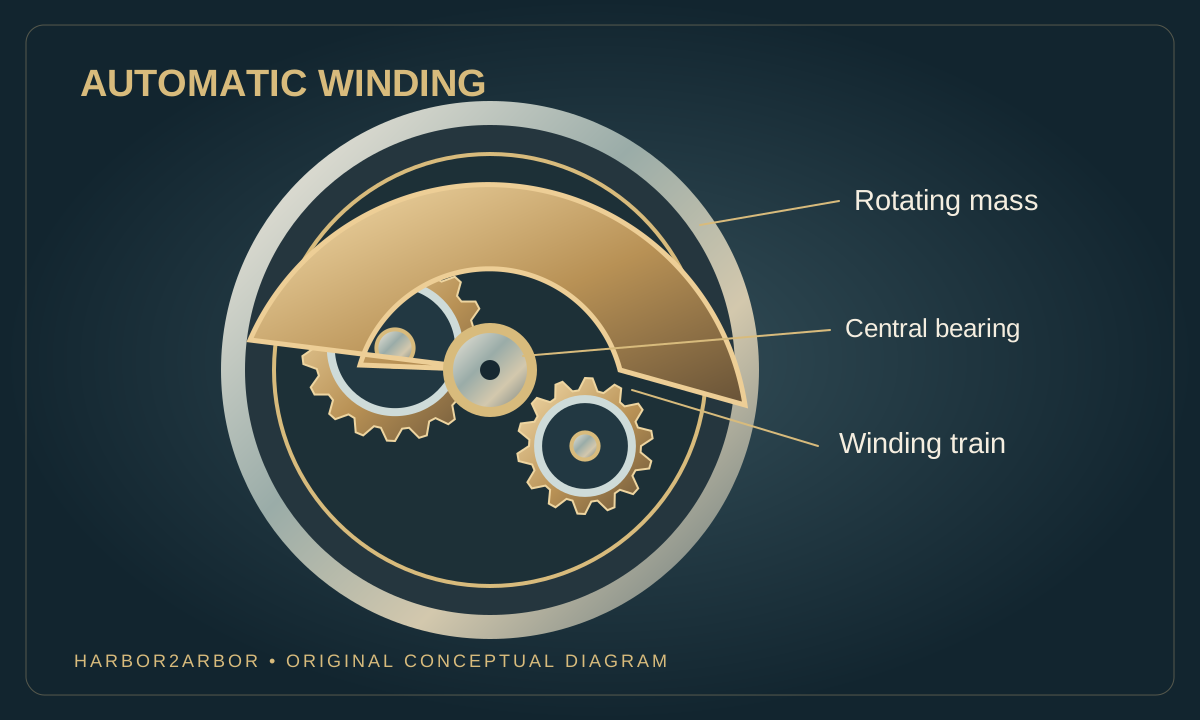
Automatic winding adds convenience
A rotor and its winding train
The rotor in an automatic watch is a weighted mass that moves with changes in orientation and acceleration. A winding mechanism turns that motion into stored mainspring energy. It does not replace the balance, escapement or gear train that regulate time.
Modern rotor layouts vary. Some move freely through a full rotation; other mechanisms differ in their direction of useful winding or how they transmit power. Individual rotor designs are not evidence that every automatic watch works identically.
An automatic watch can run down when not worn or moved enough to replenish its stored energy. The ability to keep running between wears depends on power reserve and actual usage rather than brand prestige.
Continue reading: More about this ↗ · Related history ↗
06 / ELECTRONIC TIMEKEEPING
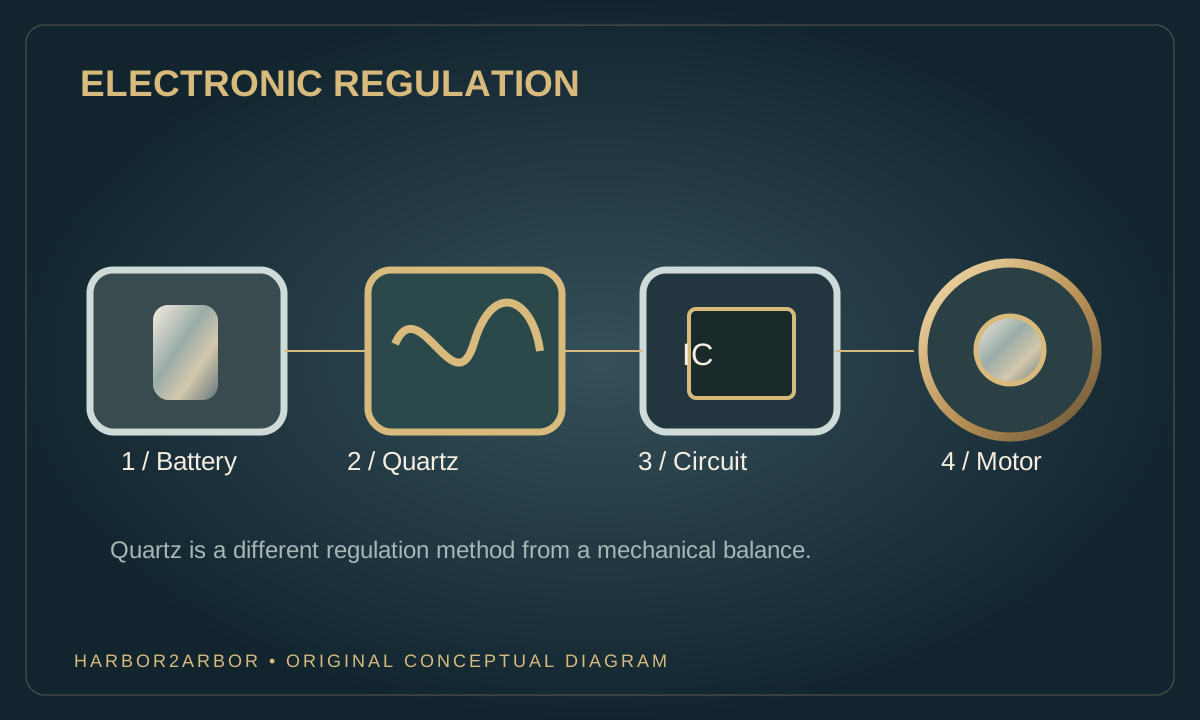
Quartz follows a different path
Battery, vibrating crystal, circuit and motor
A quartz watch uses a crystal oscillator and electronic circuit to produce a regular timing reference. An analog quartz movement typically translates that electronic signal into stepped movement of the hands through a tiny motor and reduction gearing.
Quartz accuracy is generally much higher than that of an everyday mechanical movement, but performance varies across designs. Light-powered watches such as Citizen Eco-Drive still use energy storage; they simply receive their energy from a different source.
Spring Drive is another distinct family: it uses a mainspring for energy and electronic regulation for the rate. Understanding the three systems helps explain why a visibly sweeping seconds hand or a battery compartment alone cannot always identify a movement.
Continue reading: More about this ↗ · Related history ↗
THE REAL THING / HISTORIC OBJECTS
Compare the diagrams with real watchmaking.
These photographs have been released under CC0 public-domain dedications. The source links identify the object, photographer or collection; images are not product listings or evidence of the construction of a current watch on sale.


