ORIGINS / EXHIBIT 01
The First Portable Watches
Spring-powered instruments, early cases and the problem of carrying time.
Enter exhibit ↗THE CRAFT, THROUGH THE CENTURIES
Before timekeeping became something we carried everywhere, it was a problem that occupied astronomers, navigators, engineers and generations of skilled makers. Their ideas still live inside the watches we wear.
An independently researched collection of 17 in-depth exhibits, a timeline and profiles of the people who changed timekeeping.
WELCOME TO THE DIGITAL MUSEUM
Watchmaking history is a story of inventors, navigators, craftspeople, factories and engineering teams. An accurate instrument could change a voyage. A tiny spring could change a profession. An electronic oscillator could change an industry.
Every exhibit below contains four reading chapters, a source collection and links to continue exploring. The historical collection stands apart from the storefront, but the same curiosity connects them.
THE COLLECTIONS · 17 EXHIBITS
Begin anywhere. Each exhibit is written to stand on its own, with original links to museum and institutional research.
ORIGINS / EXHIBIT 01
Spring-powered instruments, early cases and the problem of carrying time.
Enter exhibit ↗PEOPLE / EXHIBIT 02
A small spring changed precision—and sparked a dispute.
Enter exhibit ↗PEOPLE / EXHIBIT 03
Accurate time became a tool for navigation at sea.
Enter exhibit ↗MECHANICS / EXHIBIT 04
The rotating cage developed for positional rate errors.
Enter exhibit ↗PEOPLE / EXHIBIT 05
The keyless winding system changed daily watch use.
Enter exhibit ↗CULTURE / EXHIBIT 06
Waltham, standardization and interchangeable parts.
Enter exhibit ↗CULTURE / EXHIBIT 07
How aviation and military use shaped a new form.
Enter exhibit ↗MECHANICS / EXHIBIT 08
Harwood, Rolex and the evolution of the winding rotor.
Enter exhibit ↗CULTURE / EXHIBIT 09
The Oyster case and Mercedes Gleitze's Channel swim.
Enter exhibit ↗CULTURE / EXHIBIT 11
A landscape of craftsmanship, families and industry.
Enter exhibit ↗MODERN / EXHIBIT 13
A tuning-fork alternative to quartz and mechanical time.
Enter exhibit ↗PEOPLE / EXHIBIT 14
A new escapement moves from a bench to production.
Enter exhibit ↗MODERN / EXHIBIT 15
Akahane's long pursuit of quartz-regulated mechanical power.
Enter exhibit ↗MECHANICS / EXHIBIT 16
Follow energy from the mainspring to the balance.
Enter exhibit ↗MECHANICS / EXHIBIT 17
From navigation to laboratory-tested movements.
Enter exhibit ↗No exhibit matched those terms. Try a maker's name, a movement or an era.
THE FACTORY FLOOR / NEW DOCUMENTARY ROOM
See how watches are really made: industrial machines, skilled hands, precise assembly and rigorous quality testing. Curated documentary footage from Tudor, Grand Seiko, Mühle-Glashütte and NOMOS sits alongside explanations of the tools and processes.
Explore factory films and guides ↗NEW MUSEUM WING / BRAND HERITAGE
A brand's contribution can be an invention, a design principle, a manufacturing technique or a watch trusted in a demanding situation. Explore independently researched histories of Rolex, Tudor, Omega, Seiko and more—even when their watches aren't listed for sale.
SPECIAL EXHIBIT / TIME ON DUTY
Six branches, from the Army's field watches to the Navy's chronometers, Marine Corps coordination, Air Force cockpits, Coast Guard watchkeeping and Space Force atomic timing. A history of purpose and precision—not military-branded merchandise.
Explore the six-branch military history exhibit ↗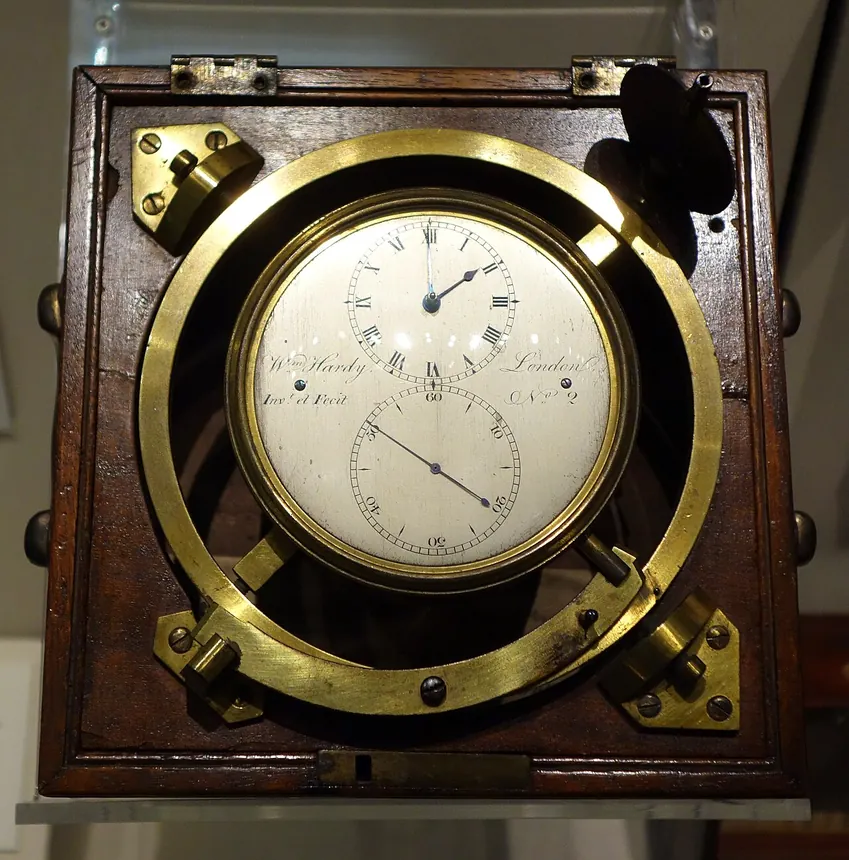
FOUR SUGGESTED TOURS
Spring-powered watches, the balance spring and Harrison's navigation breakthrough.
Begin with the first watches →Understand the gear train, escapements, tourbillons and winding systems.
Begin with movement anatomy →The industry of the Swiss Jura, American watch factories and wrist-worn time.
Begin in the Jura →Tuning forks, Seiko's Quartz Astron and the Spring Drive experiment.
Begin with Accutron →THE MECHANISM ROOM / FOUR ESSENTIAL STAGES
Most conventional mechanical watches share the same energy story. Follow it from stored spring force to the rhythm that makes the watch keep time.
Stores the energy added by a crown or automatic winding rotor.
Transmits that energy and establishes ratios for the hands.
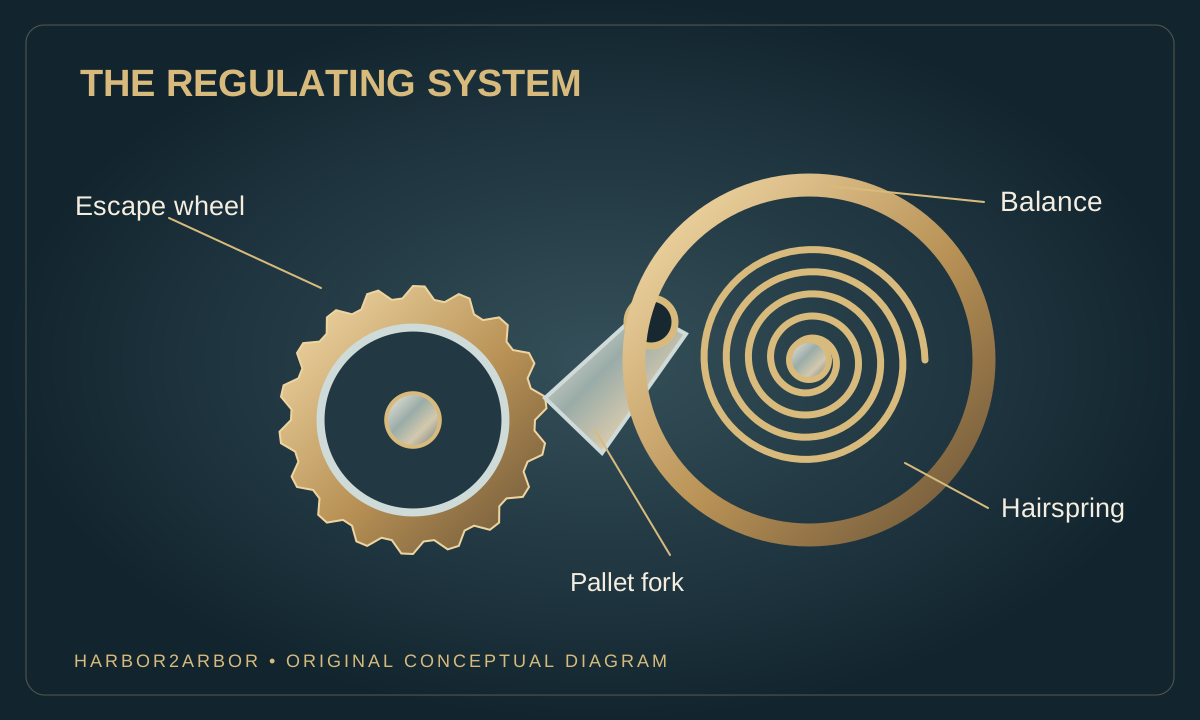
Meters the release and supplies impulses to the regulator.
Oscillates at a rhythm that allows the train to count time.
THE OBJECT ROOM / REAL COLLECTIONS
These surviving timepieces are held by museums. Their original collection records contain photographs and curatorial details. Harbor2Arbor links to those records rather than copying copyrighted collection photography.
A physical example of an invention that made the minute hand genuinely useful.
Visit the Science Museum object ↗A marine timekeeper built to solve an unforgiving navigation problem.
Visit Royal Museums Greenwich ↗The first marketed quartz wristwatch, with an original electronic module preserved.
Visit the Smithsonian object ↗A maker's interpretation of a new mechanical escapement at the dawn of production.
Visit the Science Museum object ↗01 / THE EVOLUTION
This is a selective timeline, not a claim that any one person invented the watch. Progress has almost always been collaborative.
As spring-driven clocks and watches became smaller, the central challenge shifted toward regulating a mainspring's changing supply of energy accurately enough to carry time.
Christiaan Huygens demonstrated a balance-spring approach that substantially improved portable watch regulation, with the skilled maker Isaac Thuret building an early example.
John Harrison completed H4, a small marine timekeeper that helped make determining longitude by accurate time comparison practical.
Abraham-Louis Breguet patented a rotating cage for the escapement and balance, intended to average positional rate errors in pocket watches.
Jean-Adrien Philippe developed a keyless winding and setting system, an important step toward the crown-operated watches familiar today.
Seiko launched the Quartz Astron, showing what a miniature quartz oscillator and electronic regulation could do for wristwatch accuracy.
George Daniels introduced his co-axial escapement in the 1970s; separately, Yoshikazu Akahane's Spring Drive concept led to a production Seiko watch in 1999.
02 / THE PEOPLE
The movement on a watch dial rarely tells you the entire story. These are some of the people who shaped what happens beneath it.
The balance spring
A scientist who brought a new level of regularity to mechanical timekeeping. His work on pendulum clocks and sprung balances changed the precision that portable watches could achieve.
Historical reference ↗The marine timekeeper
Sea travel required reliable longitude. Harrison's H4 helped prove that a compact, accurate timekeeper could work aboard a moving ship—an achievement closely tied to maritime navigation.
See H4 at Royal Museums Greenwich ↗The tourbillon
Breguet's 1801 patent placed the regulating components in a rotating cage. The tourbillon was devised to address positional timing errors in pocket watches and later became a symbol of high watchmaking.
About the original tourbillon ↗The keyless winding system
Philippe's winding and hand-setting mechanism removed the need to use a separate key for everyday operation. He later joined Antoine Norbert de Patek in Geneva.
The founders' history ↗The co-axial escapement
An independent watchmaker who revisited the mechanism that releases power to a movement's balance. His co-axial escapement was later adopted for commercial watches.
Daniels and his escapement ↗The Quartz Astron
The Astron was a team engineering achievement. By shrinking quartz timekeeping to wristwatch scale, Seiko helped transform everyday expectations about accuracy and affordability.
The Astron at the Smithsonian ↗The Spring Drive concept
Akahane imagined a watch powered by a mainspring but regulated electronically. His long-running work with Seiko engineers helped bring Spring Drive to reality, with the first commercial release following in 1999.
Seiko Museum history ↗03 / UNDER THE DIAL
A mainspring stores energy. A gear train transfers it and an escapement meters its release. In automatic watches, a rotor winds the spring as the wearer moves.
A battery-powered electronic circuit counts the vibrations of a quartz crystal. That consistent reference lets quartz movements keep precise time with relatively few moving parts.
A wound mainspring provides power, but an electronic regulator controls the rate without a conventional escapement. The result is a smoothly gliding seconds hand.
Want the practical difference for a watch you might wear? Read automatic vs. quartz watches, explore the watch glossary, or try the Movement Lab.
KEEP EXPLORING
Learn the terminology first, explore how a movement works, then compare current watches for the details that matter to you. Historical information here is educational—not a claim about the specifications of every model for sale.