CHAPTER 01
Lot 53 sets a record
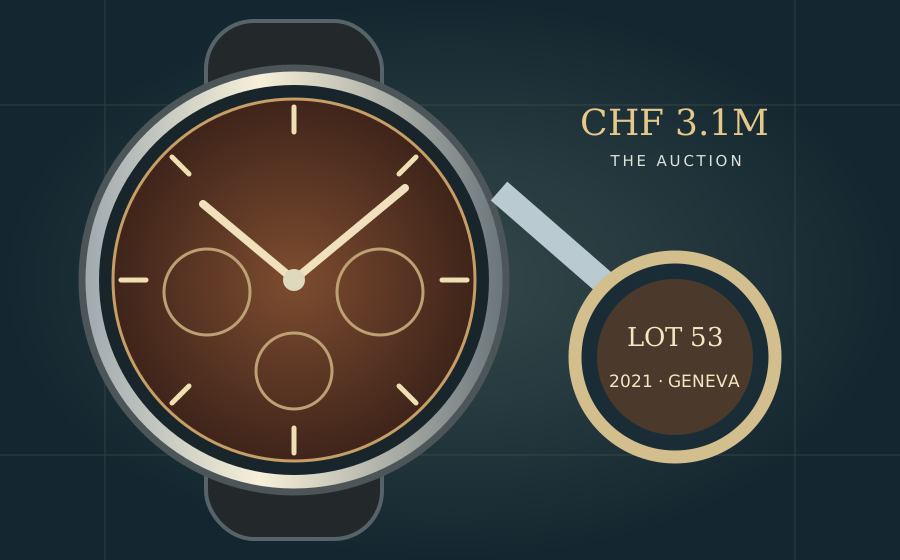
Phillips offered a 38 mm steel Speedmaster with broad-arrow hands, a striking chocolate-brown “tropical” dial and manual-wind calibre 321. Its estimate was CHF 80,000–120,000; the final result, including fees, was CHF 3,115,500—about US$3.4 million at the time. The result was over 25 times the upper estimate.
The auction catalogue identified the movement as number 15'500'006 and included an Omega Extract from the Archives noting production on 22 November 1957. Those are documented features of the auction listing, not independent proof that every part had remained together since manufacture.
CHAPTER 02
The unusual buyer
Omega later confirmed that it had purchased Lot 53 for its museum in Biel/Bienne. Watchmakers sometimes reacquire historically important objects for their archives, and the early CK2915 Speedmaster is a landmark in the line’s history.
The 1957 Speedmaster belongs to the model family that preceded the NASA-qualified Moonwatch. It is historically significant in its own right; the disputed 2021 example should not be confused with all original CK2915 watches.
CHAPTER 03
Why it was called a “Frankenwatch”
Investigators and collectors raised questions about the relationship between the dial, bezel, caseback, hands and movement. In June 2023, Omega described the object as an assembly of mostly genuine Omega components with a misleading history. The term “Frankenwatch” refers to a watch built from parts that did not originally belong together; it is not necessarily an entirely counterfeit watch.
Omega alleged that former employees and intermediaries helped create and promote a false provenance and submitted a criminal complaint. Phillips said it too considered itself a victim of alleged wrongdoing and noted that it had sought information from Omega before the sale. These are reported allegations and company positions, not findings of guilt by a court.
CHAPTER 04
The account is contested
Reporting in January 2026 by The Economist presented an account from former Omega Museum director Petros Protopapas challenging the company’s version of events and making counter-allegations. Those claims are disputed. The available reporting reviewed for this exhibit does not establish a final criminal judgment, so the roles and intentions of individuals should not be presented as proven.
The confirmed core of the story is narrower but compelling: an extraordinary auction result, Omega’s disclosed purchase, and subsequent serious questions about whether the watch was original as assembled.
CHAPTER 05
What the paperwork could not tell us
An archive extract can support details such as a recorded movement number, production date or model information. It cannot, by itself, prove that a particular dial, case, bezel, handset and movement left the factory together or remained untouched for decades.
For collectors, this case is a warning against relying on a single signal—even one from a respected manufacturer or auction house. Period consistency, evidence of replacement or restoration, and traceable ownership records must all be considered. Continue with the linked vintage-watch authentication guide.
The central lesson
Authentic components are not the same as an original, historically coherent watch. Distinguish documented facts, company claims, expert opinions and unresolved allegations. For a practical checklist, see How to authenticate a vintage watch.
RESEARCH LIBRARY
Sources and further reading
Links lead to the original auction listing and independent reporting. Quotations and claims are attributed; source photographs are not republished here.